

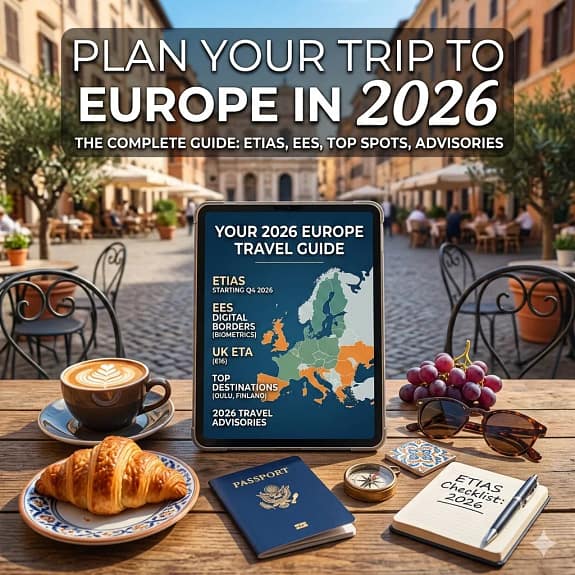
Plan your trip to Europe in 2026 with this complete guide ETIAS, EES border rules, visa requirements, top destinations, and current travel advisories.
Europe remains one of the world’s most captivating travel destinations but 2026 brings a new landscape for international visitors. From sweeping digital border changes to growing local tensions over mass tourism, planning a trip to Europe requires more preparation than ever before. This guide answers the most pressing questions travelers are asking, so you can explore with confidence.
If you are planning a trip to Europe, two major changes have reshaped what you need to prepare before boarding your flight.
1. The Entry/Exit System (EES) Already in Effect
The EU’s Entry/Exit System launched on October 12, 2025, and is being rolled out across 29 Schengen Area countries, with full implementation expected by April 10, 2026. This new digital border management system replaces the traditional passport stamp with biometric data collection. Upon your first entry, authorities will record your fingerprints, facial image, passport details, and travel dates all stored digitally.
There is no advance action required, and no fee for the EES itself. However, travelers should allow extra time at border crossings especially at major airports like Frankfurt and Amsterdam Schiphol while the system is ramping up. Children under 12 are not required to provide fingerprints, but they will need a facial scan.
2. The ETIAS Authorization Coming Late 2026
The European Travel Information and Authorization System (ETIAS) is the bigger headline for future travelers. Think of it like the U.S. ESTA system an online pre-travel authorization required before you fly, not a visa. ETIAS is expected to go into effect in the fourth quarter of 2026, following the successful implementation of the EES.
Key ETIAS facts:
- Who needs it: Citizens of over 60 visa-exempt countries, including the United States, Canada, Australia, the UK, and Japan.
- Cost: Approximately €7–€20 depending on the source, waived for travelers under 18 or over 70.
- Validity: Three years, or until passport expiry whichever comes first.
- Application: Entirely online, taking just a few minutes. Approval is typically granted within minutes, though it can take up to 96 hours.
- Important: As of March 2026, the application portal is NOT yet open. Do not use unofficial third-party sites. Apply only through the official EU portal: travel-europe.europa.eu/etias.
- Coverage: Required for stays up to 90 days in any 180-day period across 30 European countries.
For now, travelers heading to Europe in 2026 before ETIAS launches do not need to apply for anything in advance beyond the UK’s ETA (see below).
What About the UK? The Electronic Travel Authorization (ETA)
The United Kingdom is not part of the Schengen Area, and it has launched its own pre-entry system. As of January 8, 2026, U.S. and other eligible travelers must obtain a UK Electronic Travel Authorization (ETA) before visiting Great Britain including Northern Ireland. The ETA costs £16 (approximately $21), is valid for two years, and allows multiple entries. Applications are processed online and can take up to three days.
Note: Neither the UK ETA nor the EU’s ETIAS is required for short visits to the Republic of Ireland, which is not part of the Schengen Area or the UK.
Visa Requirements: Do Americans Need a Visa to Visit Europe?
For the vast majority of travelers from the United States, Canada, Australia, Japan, and dozens of other nations, no traditional visa is required for short stays in Europe’s Schengen Area. The 90-day limit within any 180-day period remains in effect. Once ETIAS launches later in 2026, that online authorization will effectively replace the no-requirement status for visa-free travelers but it remains a far simpler process than a traditional visa.
Travelers planning longer stays, study programs, or work assignments will still need to apply for the appropriate national visa through the embassy of their destination country. ETIAS does not cover extended stays.
Passport reminder: Your passport must be valid for at least three months beyond your planned departure from the Schengen Area. Six months of validity is strongly recommended.
Best Destinations for Travel to Europe in 2026
While the classic draws of Paris, Rome, and Barcelona remain as magnetic as ever, 2026 offers several compelling reasons to explore beyond the beaten path.
Oulu, Finland The Most-Recommended Destination of 2026
Recommended by Afar, BBC, CNN, Condé Nast Traveller, National Geographic, and Travel + Leisure, Oulu is the European Capital of Culture for 2026. The Finnish city’s programming includes the debut of Ovllá (an opera on the history of Europe’s only indigenous peoples, the Sámi), a Climate Clock public art trail, and the Arctic Food Lab showcasing northern culinary culture. It’s a far cry from summer crowds in southern Europe.
Greece The Peloponnese and Celestial Events
With 2026 featuring the solar cycle’s peak and multiple supermoons, Greece’s ancient landscapes are attracting those chasing celestial spectacles. The Peloponnese peninsula home to Nestor’s Cave and the ancient city of Pylos is drawing travelers inspired by the upcoming film The Odyssey. Sicily’s Favignana island is also trending for similar reasons.
Eastern Europe Hidden Gems Without the Crowds
For travelers concerned about overtourism (more on that below), Eastern European capitals offer a compelling alternative. Warsaw, Prague, Budapest, Sofia, and Zagreb combine rich history, vibrant culture, and fewer crowds and many carry the U.S. State Department’s lowest Level 1 travel advisory, meaning standard precautions are sufficient.
Why Are Europeans Protesting Against Tourists?
Summer 2025 will be remembered as the season Europe’s relationship with mass tourism reached a breaking point. In Barcelona, locals sprayed visitors with water guns. In Mallorca, thousands marched in the streets. Louvre workers went on strike. A planned mega-wedding in Venice was relocated after protest pressure. The word on everyone’s lips: overtourism.
The numbers tell the story. Europe welcomed 747 million international travelers in 2024 more than any other region on earth. France alone received 100 million visitors, nearly 50% more than its total population. Spain drew 94 million tourists against a population of 49 million. In Venice, a city of 49,000 permanent residents, 20 million tourists arrive annually.
The core grievances are practical and deeply felt: soaring housing costs driven by short-term rental platforms, neighborhood character lost as local shops are replaced by souvenir vendors, overwhelmed infrastructure, water scarcity on popular Mediterranean islands, and the general sense that residents feel displaced in their own cities.
Travel experts caution that these protests are better understood as anti-mismanagement movements rather than anti-tourist ones. Protesters are largely directing their anger at local governments, demanding better regulation of cruise ship arrivals, crackdowns on Airbnb-style short-term rentals, and smarter destination planning. Most locals still want visitors they simply want sustainable tourism that preserves their quality of life.
For travelers in 2026, this context matters. Staying in hotels rather than residential Airbnbs, visiting during off-peak seasons, exploring lesser-known neighborhoods, and choosing secondary cities over perpetually crowded hotspots are all ways to travel as a welcome guest rather than a contributor to the problem.
Current Travel Advisories for Europe
The U.S. State Department’s four-tier advisory system provides important guidance for American travelers:
- Level 1 (Exercise Normal Precautions): Poland, Czech Republic, Bulgaria, Croatia, and many Eastern European nations. These are generally safe and welcoming for tourists.
- Level 2 (Exercise Increased Caution): France, Germany, Spain, Italy, the UK, and most of Western Europe carry this advisory, primarily due to terrorism risk awareness. Millions visit safely each year by staying alert, securing belongings, and avoiding isolated areas at night.
- Level 4 (Do Not Travel): Ukraine, Russia, and Belarus due to ongoing armed conflict and safety concerns. Travelers are strongly urged to avoid these countries entirely.
Health alert (March 2026): The CDC has issued a Level 2 health advisory for travelers to Germany, Spain, the UK, and several other European countries, urging visitors to be up-to-date on polio vaccinations due to circulating poliovirus. Confirm your vaccination status before travel.
Additionally, the U.S. State Department has advised travelers to exercise caution in popular tourist areas across Spain and Italy due to the possibility of anti-tourism demonstrations. This does not mean avoiding these destinations it means being aware of your surroundings and following instructions from local authorities.
Can I Still Travel to Europe from the USA?
Absolutely, yes. Despite the headlines about ETIAS, border digitization, and overtourism protests, Europe is very much open for business and Americans remain among the most welcome visitors on the continent. The new entry systems are designed to make borders more efficient and secure, not to discourage tourism.
For trips planned before late 2026, the main change to navigate is the EES biometric check at the border which requires no advance action, just a bit of extra patience during your first crossing. The ETIAS application, once live, will be a straightforward online process taking just minutes.
Your 2026 Europe Travel Checklist
- Check your passport validity: ensure it is valid for at least 6 months beyond your planned return date.
- UK travelers: apply for the UK ETA (£16) at eta.homeoffice.gov.uk before your trip.
- EES (April 2026 onward): no advance action needed just allow extra time at the border for biometric registration.
- ETIAS (late 2026): watch the official EU site (travel-europe.europa.eu/etias) for the application launch. Do NOT use third-party sites.
- Check current travel advisories at travel.state.gov and health notices at the CDC website.
- Consider traveling in shoulder season (April–May or September–October) to avoid summer crowds and overtourism flashpoints.
- Enroll in the Smart Traveler Enrollment Program (STEP) at step.state.gov to receive real-time alerts from local U.S. embassies.
- For Spain and Italy especially: stay informed about local protest activity and keep a flexible itinerary.
Europe in 2026 is changing but the romance, culture, history, and cuisine that have drawn travelers for generations remain as extraordinary as ever. With a little extra preparation and a mindful approach to where and how you travel, your European adventure can be both seamless and deeply rewarding.